
You come across a leadership position that sounds like an exciting next step in your career.
As you read through the qualifications, your attention shifts from all the strengths you have to offer to the things you haven’t yet done in your career.
And before you know it, you’ve talked yourself out of applying.
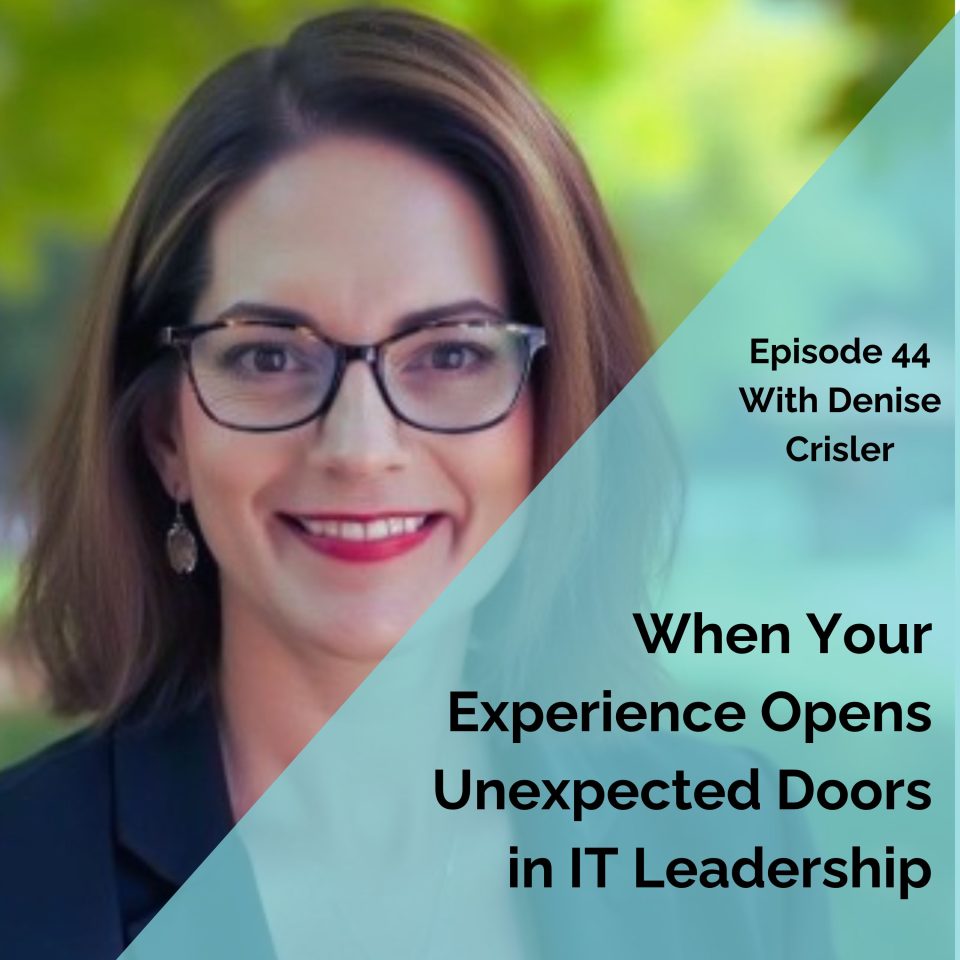
In this week’s episode, I’m joined by Denise Crisler, who shares how she transitioned from HR leadership into cybersecurity by leveraging her transferable skills.
We’ll discuss why you should be willing to pursue opportunities even when you meet only 60% of the qualifications, and why the ability to communicate complex information to different audiences is an invaluable leadership skill.
Denise also shares the importance of continually developing your leadership skills and being willing to advocate for yourself when your responsibilities extend beyond the level of your position.
How Women Leaders in IT Leverage Their Strengths and Advocate for Their Value
Tina: Joining me today on the Empowered Women in IT podcast is Denise Crisler. Denise and I met through a mutual colleague, and I’m so excited that we were able to connect today and be able to learn from Denise. Denise, welcome.
Denise: Thank you, Tina. I’m excited to be here.
Tina: Oh, that’s so wonderful. Denise and I have had quite a challenge trying to connect our schedules. So I feel like all the stars aligned today. I’m so grateful for that.
Denise: Me too.
Tina: So Denise, I want to start out by asking this question. You transitioned from leadership in HR to cybersecurity. How did that opportunity come about and what made your HR experience valuable in that role?
Denise: Yeah, that’s a fun one. So with cybersecurity, one thing to always remember, every day is a new day and something different happens. So as we are seeing the maturity within the field itself, there was a definite need to understand the human risk side of it. And a former colleague I worked with, who had stepped in a new role with an organization that was trying to secure a cybersecurity certification and various frameworks, said there’s this new area, you know, where we have to understand the learning ends of all users and implementing best practices. And how do we get that changed behavior?
We need communications to be directed to all users and not dive into a technical side of that. And just came to me and said, I think you would be incredible at it. And I said, I don’t even know anything about cybersecurity. And what I think I then learned is this particular area, what I refer to as human risk or cultural awareness and training, you might hear something like that with cyber, is all about the people side. It’s how we are changing behavior. And I think that was the start of something that’s been incredible in my experience.
Tina: I just absolutely love that. And, you know, having worked in IT throughout my entire career, I really understand the importance of the human side, because even though we may understand things from a technical perspective, if we’re not understanding, oh, scammers are going to ask you these kinds of questions, they’re going to know certain pieces of information about you, all those kinds of things. That human side is, in my opinion, invaluable.
Denise: It is. And I have a, I guess, a mantra that everything that an individual is learning about this side of cybersecurity can be applied at work, but they can also take it home. That’s really important.
Tina: Yes.
Denise: They have that direct buy-in. I’ll talk about multi-factor here at work, but it’s a big win for me when I know someone goes home and talks to the family at the dining room table about what MFA is and why it’s important.
Tina: Yes, absolutely. Definitely tracking with you on all of that. So, I love that. So, Denise, as you transitioned into your new role, you realized that you and your leadership had different views about the level your role needed to be. So, I’d love for you to talk about how you navigated that and what information or clarification helped them understand your perspective.
Denise: You know, I think this has happened a couple of times throughout my career where the role in this particular area within cyber, it’s really viewed as from people who may not understand how we do transformational change in a broad, large organization, that it’s not just creating a training and sending it out.
You know, there’s a lot of strategic effort. There’s executive partnerships, there’s the buy-in and mitigating risks. And of course, there’s the resistance that we have to work through. But with the role where maybe some organizations have viewed it as somebody who might just develop comms, create a couple of trainings, you know, I’ve been advocating for quite some time being in this role at various companies for now over 10 years, that there’s a lot more to it.
And I think it’s really not intentional. It’s just kind of a lack of understanding. Maybe there are people that are leading up cybersecurity organizations that really have a high technical aptitude. They may not quite understand the people’s side of it, and then what that would take to enable that change. So I think that’s where I’ve come in to clarify what needs to be at that level for the whole of the organization.
Tina: Love that. I just want to ask a follow-up question to that. So what helped you keep going, even when you encountered resistance along that pathway?
Denise: Well, I’d like to joke and probably say there was a glass of wine involved with that. Maybe that’s not a joke. I think it’s my relentless effort. I really am confident and this is the right thing to do and what it would need. And truly, I think it’s just a matter of having those crucial conversations. And there weren’t always wins.
There are some people who are still, you know, adamant about what this is, you know, it’s just training and comms, you know, it’s, it’s not anything more than that. But this person also oversees things like the professional development of the cybersecurity organization. And there’s that HR scope that comes back in that area as well. So I think it’s just continually not giving up on what I think I know to be right. And then having those pockets of people who are true advocates, whether male or female, you know, there’s just been a lot of people that had supported the effort. And I’m grateful for that.
Tina: Beautiful. And I talk a lot about allies and advocates in my program that I work with women on and I truly understand the value of both of those in our careers. Coming from an HR background, how did you build credibility with your cybersecurity colleagues? And what has helped you earn their trust?
Denise: I think right out the gate, I’m known for being a leader in this part of cybersecurity. But, you know, anywhere you go into it, being a new individual and providing that worth from an HR background as well, way, way back in the day, I understand learning. And so, you know, if we’re throwing a YouTube video, we’re not going to call that learning and having those conversations around performance-based objectives and how we’re going to measure people acquiring this new information and then we can assess them to see that that knowledge transferred. These are areas maybe they just hadn’t even heard of before and they were open to, they just weren’t aware of it.
So bringing the learning into the development, even performance management capabilities, and of course, communications and communicating to our direct audience. You know, what I would say to my fellow cybersecurity professionals about a certain topic or anyone in IT would be very different than what I would do to a broad audience of all users and the vernacular I would use or to support. Not that they wouldn’t be aware of it, but if they’re just being introduced to something like AI-generated phishing attacks, you know, there’s more knowledge and comfort level with an IT professional versus maybe somebody that’s just not sure what we’re talking about and helping that support them. So that learning those HR skills, those transferable skills, I’ll say, whether it’s in HR or another area is very important.
Tina: Yes, absolutely. And I definitely relate when you’re talking about being able to communicate, communicating to the broader audience, because if a technical organization tries to do that on their own, it doesn’t work well. I’ve seen that fall flat on its face multiple times.
Denise: Yeah, I’ve seen that too. And I think it’s, you know, sometimes they have to learn the hard way, right, Tina?
Tina: Yes.
Denise: In order to support them.
Tina: Yeah, absolutely. For a woman leader in IT who believes she’s being offered a role below the level of responsibility she’ll carry, what would you encourage her to do first?
Denise: Yeah, it’s a challenging question. I think also because it’s a challenging job market, given what we’re seeing today. And I think it’s, there’s also an opportunity when we think about women and men applying for roles.
I think there’s a statistic out there that a man would apply for a role if they have 60% of the skills. Women are usually reluctant based off of 80 or 100%. They have to have that confidence that they’ve done those things. But that’s not what we’re necessarily looking for
I would advise anyone looking at a role to consider something that a portion of it they haven’t done before. I mean, why would we want the same standard role we had somewhere else anyway? We want to stretch ourselves and learn new skills. I think if I was advising a woman today on a role it is to make sure they’re looking at roles that might be the next step up, not necessarily a lateral move.
A lateral move in another organization, though, is a stretch, too, because there’s going to be different challenges and opportunities found in a new company. But I think that would help that individual when they feel stuck on what roles they’re applying to. If they’re in the role, they are seeing that there are opportunities to express or communicate more about the vast level of responsibility that they’re executing on then I think that’s the conversation to start having with their leadership.
Tina: Yeah, absolutely. And I love one of the things that you said at the beginning. You talked about determination and how you were just very determined when it came to encountering some resistance from leadership. And I think that is so important for women just not to give up. Maybe they have a bad experience with one role that they apply for. But, you know, it’s like anything else in life, the more that you do it, the better you get.
Denise: True. And it hasn’t been all roses for me, I’ll tell you. You know, there has been some challenges there along the way, but more good than bad. And that’s what I think we have to embrace. But realistically, it is a challenge that I would just recommend everyone to take, to take that on.
Tina: Yes, absolutely. Be willing to take the risk.
Denise: Yes, definitely.
Tina: For our last question today, I would love for you to share what is one of the most important leadership lessons you’ve learned throughout your career that you love to share with other women?
Denise: Oh, there’s many that I can go in this direction, Tina. I think there’s an opportunity to remind ourselves that even in a heavy technical role, at the end of the day, we are all people. And we have our unique needs, our professional goals and our development. And we also have our personal and professional lives. So I think the human element is key.
I think what I’m seeing in tech and cybersecurity is oftentimes maybe the technical skills are prioritized over leadership acumen. I would advise people, and something that I think I have done throughout my career, is to make sure you’re keeping up on those leadership competencies in addition to the technical. That will only move the needle because people will want to be on your team.
I’m proud that I have people that would just really value what I bring to the table as their leader. And I think that’s a leadership lesson that I would advise everyone to consider.
Tina: I wondered if you could unpack that a little bit more and talk about what some of those leadership skills are.
Denise: Sure. I think within cybersecurity, one that’s really important is communication. I would even say storytelling. We have a lot of great examples of the things just going south pretty quickly and the challenges the organization faces.
And we’ve got a lot of strong technical skills that our team can apply to that, as well as resources with various vendors and solutions. But I think it’s beneficial to advise all of our leaders to be able to tell the story to the rest of the organization. That helps people humanize it. That helps them understand what we’re really talking about when we say we need to prioritize verifying a link that we might receive in an email that we’re not so sure about.
And having that skill to be able to communicate to multiple audiences, not just the board or the executives, although that is a very important one, but all the way down to somebody who’s just not still not so sure about why they need to care about any suspicious email that they receive.
Tina: Yeah. I love that. And so, so true, that ability to communicate. I feel like that is a skill that is often undersold.
Denise: I would agree with that. I think a deeper dive with that too, I’d like to share is sometimes the communication. I think all of us can ask those clarifying questions. If the communication comes back and there’s still ambiguity or uncertainty, I think we all lean forward and just make sure we’re vetting out what we all understand to be the end state. And that only helps support teams or projects and initiatives if we’re all clear on what our end goal is.
Tina: Yes. Beautiful. And well stated.
Denise: Thanks.
Tina: Love clarity too.
Denise: Right. I think oftentimes if we’re guessing at it, that’s a time, like a flag to pause, and then we can regroup and make sure we’re driving towards our objectives and key results.
Tina: Yes, absolutely.
Well, Denise, I just want to thank you so much for your time today. I love everything you shared and I know it will be so valuable for women that find themselves in a situation similar to what you experienced where you’re hired for a role and there happens to be a difference in how they view the level and then being able to navigate that.
Denise: Absolutely. I think it’s also important for me to remind all of your listeners out there, like really consider your transferable skills. So if you’re wanting to pivot into another area, a lot of people are joining into cybersecurity. We can’t get enough people considering this field. So I would love that, but definitely evaluate from that perspective and not just what you’ve done, like what you could evolve to.
Tina: Such great advice. Thank you so much.
Denise: You’re very welcome, Tina.
Tina: Thank you.